
Loneliness Epidemic Statistics 2026: How Many Are Truly Alone?

Every hour, one hundred people die from causes directly linked to loneliness.
That figure comes from the World Health Organisation's Commission on Social Connection, released in mid-2025, and it is not a metaphor. It is a mortality count.
This article is a data intelligence report on the loneliness epidemic as it stands in 2026. It draws from population studies, clinical meta-analyses, government health advisories, and economic modelling to map the true scale of social disconnection, not as an emotional concept, but as a measurable, deadly, and extraordinarily expensive public health condition.
Loneliness Epidemic Statistics: 1.3 Billion People Are Lonely Right Now
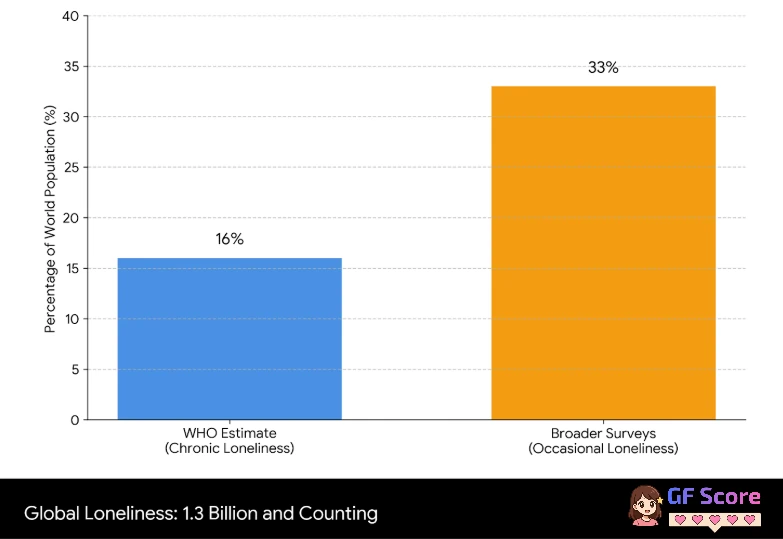
The WHO Commission on Social Connection estimates that approximately 1 in 6 people globally, roughly 16% of the world's population, experience loneliness.
That translates to over 1.3 billion people, and it is almost certainly an undercount.
The 16% figure reflects the conservative end of peer-reviewed prevalence data. Broader self-reported surveys using less clinical definitions find that approximately 33% of adults worldwide report feeling lonely.
The gap between 16% and 33% is not a contradiction; it is a measurement artefact. The WHO figure tracks frequent or chronic loneliness, while the broader estimate captures occasional and moderate experiences. Both are valid, and both point in the same direction.
🤔 Why Loneliness Is the Hardest Epidemic to Measure
Loneliness is among the most difficult public health metrics to standardise. Unlike blood pressure or BMI, it cannot be tested objectively.
The most widely used instruments, the UCLA Loneliness Scale and the De Jong Gierveld scale, measure perceived isolation, not social contact frequency.
Two people with identical social calendars can score very differently depending on the quality, not quantity, of their connections.
This distinction is critical because it explains why people who appear socially active can still register clinical loneliness, and why population-wide intervention strategies built purely around increasing social contact have had mixed results.
Different surveys also use different recall windows and thresholds. Some ask about loneliness “in the past week”; others ask “in the past year”.
This produces results that range from 16% to over 60% depending on methodology alone.
The practical implication: no single headline number fully captures the epidemic. What matters more is the direction of change across all measurement frameworks, and that direction is consistently upward.
🌍 Global Loneliness Rates: The Numbers Behind the Crisis
The WHO's 16% global figure becomes significantly more alarming once disaggregated.
Loneliness rates are approximately twice as high in low-income countries (around 24%) compared to high-income countries (around 11%).
This inverts a common assumption, that loneliness is primarily a wealthy-world problem caused by nuclear family structures and digital isolation. The data suggests poverty, limited mobility, and absent infrastructure for community engagement are equally powerful drivers.
Among older adults globally, a meta-analysis of data from 36 countries puts prevalence at 27.6%.
The highest rates are in North America, at 30.5%. Older women report higher rates than older men (30.9%), and institutionalised older adults register 50.7%, a figure that warrants separate policy attention entirely.

🇺🇸 America's Loneliness Crisis: From Advisory to 2026 Data
The United States has been one of the most data-rich environments for studying loneliness, which makes its trajectory particularly legible.
In 2023, the U.S. Surgeon General issued a formal advisory declaring loneliness a national epidemic, at the time, data suggested approximately 50% of American adults experienced significant loneliness.
That advisory compared the health risk of loneliness to smoking up to 15 cigarettes per day, placing it alongside obesity and addiction in terms of systemic public health burden.
By 2025, a nationally representative study published in Social Psychiatry and Psychiatric Epidemiology found that 37.4% of U.S. adults experienced moderate to severe loneliness, specifically 23.5% moderate and 14.0% severe.
That 37.4% figure captures only the clinically significant range.
Including people with mild or periodic loneliness, CivicScience's ongoing national tracker finds roughly one in three U.S. adults currently report loneliness, down four percentage points from the prior year's peak, but elevated relative to 2023 baselines.
AARP's research on adults aged 45 and older offers a separate signal: 40% of U.S. adults in that age group now report being lonely, up from 35% in both 2010 and 2018.
That upward shift suggests a long-term structural increase that pre-dates pandemic disruption and has survived it.
Lonely adults in this older cohort spend an average of 7.3 hours alone each day, compared to 5.6 hours for their non-lonely peers.
That 1.7-hour daily gap is not trivial. It compounds over weeks and months into a qualitatively different life experience, with measurable downstream effects on health engagement, mobility, and cognitive maintenance.xperience, with measurable downstream effects on health engagement, mobility, and cognitive maintenance.
📱 Gen Z Is the Loneliest Generation in Recorded Data
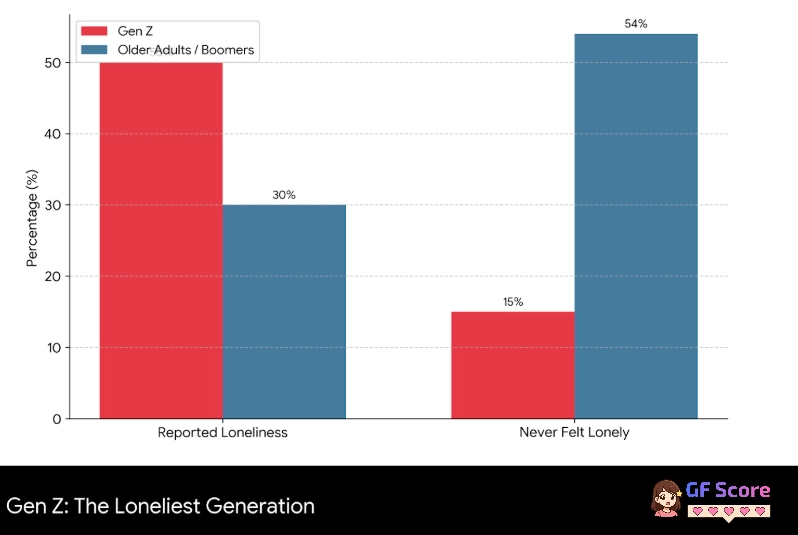
The most counterintuitive finding in loneliness research, and arguably the most diagnostically important, is the consistent discovery that young adults in their late teens and twenties report higher loneliness rates than older populations.
A March 2026 multi-country study, spanning eight countries, found that nearly half of adults aged 18–24 reported feeling lonely, compared to roughly 30% of adults aged 55 and older.
Across all eight countries combined, approximately four in ten adults reported loneliness, but the age gradient was stark and consistent regardless of geography.
Among U.S. Gen Z adults specifically, loneliness reached 57% in 2025, while simultaneously declining among older adult cohorts.
The broader demographic picture is striking:
This is not a small generational gap. It is a generational chasm.
The drivers are themselves complex and interacting. Low self-esteem accounts for 28% of Gen Z loneliness attribution; being single accounts for 24%; social anxiety accounts for another 24%.
Male Gen Z adults are disproportionately affected, over 31% of lonely young men cite being single as a contributing factor, compared to 17% of young women.
This maps onto a broader documented trend of young men's social networks contracting since the mid-2000s, driven by declining participation in civic organisations, sports leagues, religious institutions, and workplace social environments.
🔄 Social Media Makes Loneliness Worse, Not Better
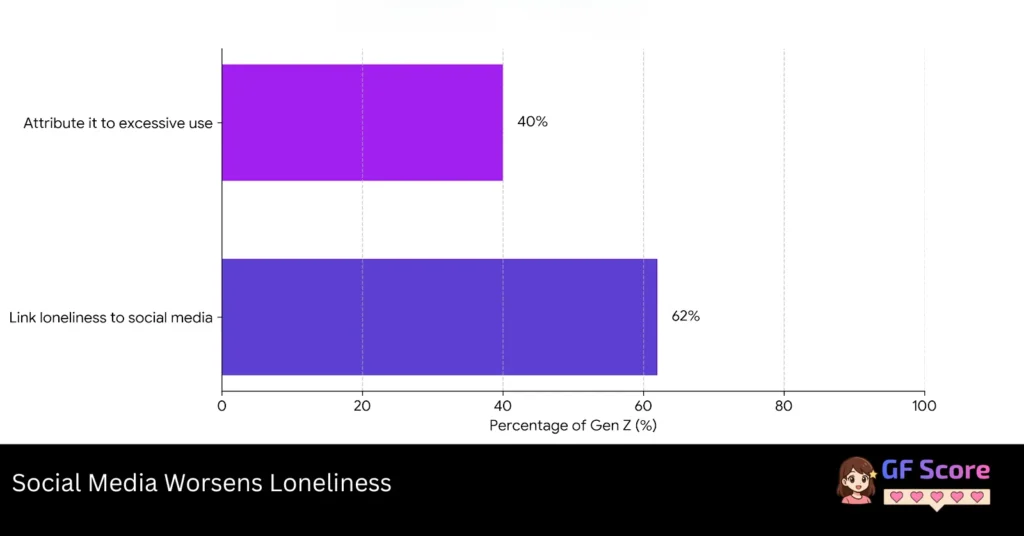
The most structurally interesting question in loneliness research right now is why rates have increased simultaneously with unprecedented growth in digital social infrastructure.
The answer emerging from longitudinal data is both clear and uncomfortable.
A 2025 Baylor University study tracked nearly 7,000 Dutch adults over nine years and found that both passive and active social media use were independently associated with increased loneliness over time.
Passive scrolling was expected to be problematic. Active posting and engagement, the kind of behaviour social platforms are designed to encourage, was also positively correlated with rising loneliness.
The lead researcher described the dynamic as a continuous feedback loop: lonely people turn to social media seeking relief, but social media use, particularly in its current reward-optimised design, may amplify rather than satisfy the underlying need.
A separate analysis found that participants spending an average of 5–6 hours per day on social media still reported social isolation.
Researchers introduced the term “authenticity–visibility paradox”, the more visible we are online, the less authentic we tend to be, and it is authenticity, not visibility, that resolves loneliness.
Among Gen Z, this is particularly acute:
The data suggests a population that recognises the mechanism feeding their isolation but lacks the structural context or individual capacity to exit it.
💔 Loneliness Kills: The Body-Level Health Data
The health consequences of chronic loneliness are no longer speculative. The evidence base is now large enough, and methodologically robust enough to draw causal, not merely correlational, conclusions.
Heart disease and stroke are the most extensively studied outcomes.
Social isolation and loneliness are associated with a 29% increased risk of heart attack or death from heart disease, and a 32% increased risk of stroke.
These figures come from a systematic review published in the Journal of the American Heart Association, drawing on multiple cohort studies.
The association holds even after controlling for traditional cardiovascular risk factors — meaning loneliness operates as an independent variable, not just a proxy for other health risks.
A 2025 meta-analysis drawing on 167 studies across 303,643 participants confirmed that loneliness is significantly associated with worse health outcomes even in otherwise healthy populations.
The relationship did not attenuate when controlling for socioeconomic status, suggesting the health burden of loneliness is not explained away by poverty or restricted healthcare access.
The WHO's most direct statement on mortality: loneliness contributes to an estimated 871,000 deaths per year globally.
That is roughly equivalent to the annual global mortality from road traffic injuries.
Loneliness Raises Dementia Risk by 31%: The Brain Data
Among the most significant findings to emerge in recent years is the relationship between loneliness and cognitive decline.
A meta-analysis of data from more than 600,000 participants across 21 longitudinal cohorts, funded by the National Institute on Ageing, found that loneliness increases the risk of developing dementia by 31%.
Broken down by condition:
These findings were consistent even after controlling for depression and social isolation as separate variables, confirming loneliness as an independent dementia risk factor.
The dose-response relationship adds further weight. Research published in 2025 examining two cohorts found that participants with severe, prolonged loneliness had a 98% higher risk of dementia and a 42% higher risk of cognitive decline compared to those with no loneliness.
A separate analysis of 133,388 adults found that experiencing both loneliness and depression together tripled the risk of dementia, compared to individuals with neither condition.
The magnitude of that combined effect is comparable to the impact of carrying the APOE e4 genetic variant, which is traditionally considered one of the strongest known dementia risk factors.
This reframes loneliness not merely as a social or mental health problem, but as a neuroprotective challenge with direct implications for cognitive ageing policy.
💸 Loneliness Costs the U.S. Economy $460 Billion a Year
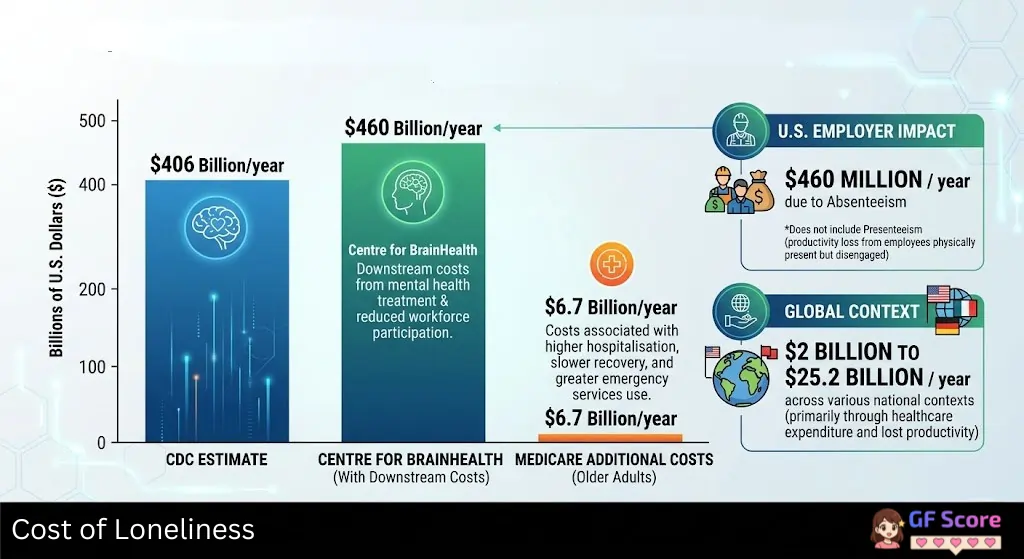
Loneliness has a measurable economic footprint, and it is considerably larger than most institutional budgets treat it as being.
In the United States, the CDC estimates loneliness costs the economy approximately $406 billion per year.
The Centre for BrainHealth places the figure higher, at $460 billion annually, once downstream costs from reduced workforce participation and mental health treatment are incorporated.
Medicare alone spends an estimated $6.7 billion per year in additional costs attributable to social isolation among older adults, costs associated with higher hospitalisation rates, slower recovery, and greater use of emergency services.
At the employer level, absenteeism driven by loneliness costs U.S. businesses an estimated $460 million per year.
This figure almost certainly underestimates total workplace impact, as it does not include presenteeism, the productivity loss from employees who are physically present but cognitively or emotionally disengaged.
A systematic literature review published in 2025 looking at global economic costs found estimates ranging from $2 billion to $25.2 billion per year across different national contexts, primarily through healthcare expenditure and lost productivity.
That range reflects variability in how countries define and measure the cost exposure, not uncertainty about whether the cost exists.
🗺️ Which Countries and Groups Are Hit Hardest
Loneliness is not evenly distributed. The data reveals predictable but important concentrations.
Low-income countries carry roughly twice the loneliness burden of high-income ones, 24% prevalence versus approximately 11%.
This is consistent with structurally driven isolation: inadequate transport infrastructure, limited community services, high physical labour demands, and weak social safety nets that leave older adults without support networks.
In the United Kingdom, one of the countries with the most granular national-level data, 49.63% of adults, approximately 26 million people, reported feeling lonely.
Around 7.1% of the British population, or 3.83 million people, experience chronic loneliness, defined as feeling lonely “often or always”.
The UK remains one of the few high-income countries to have established formal national policy on loneliness, including a dedicated Minister for Loneliness.
Among institutionalised older adults globally, those in care homes and residential facilities, loneliness prevalence reaches 50.7%, the highest of any subgroup in peer-reviewed literature.
This is a population whose social isolation is often structurally imposed: visiting constraints, cognitive limitations, mobility barriers, and the systematic loss of peer networks through death.
📈 Where Loneliness Is Heading: The 2026 Trend Signal
The pandemic-driven surge in loneliness that defined 2020 and 2021 has not simply reversed.
In some cohorts, particularly middle-aged and older adults, reported loneliness has modestly declined since 2022 highs.
In others, particularly Gen Z and young adults internationally, it has either held steady at elevated levels or continued rising.
The March 2026 eight-country study confirmed this bifurcation: older cohorts are recovering, younger cohorts are not.
This divergence matters because it suggests the pandemic was not the cause of youth loneliness, it was an accelerant of a pre-existing structural trend.
Remote learning increased Gen Z isolation by an estimated 35% during the pandemic period. But Gen Z loneliness had already been rising since 2018, registering approximately a 15% increase before COVID-19 arrived.
The structural conditions producing youth loneliness are not temporary disruptions. They include:
Meanwhile, intervention programmes targeting loneliness show social return on investment estimates ranging from $2.28 to $13.72 per dollar spent, a range that compares favourably to many standard public health expenditures.
The data, taken in full, does not present a picture of a problem that is plateauing.
It presents a problem that is becoming structurally embedded in the social fabric of the most digitally connected generation in human history, while simultaneously imposing measurable, quantifiable costs on health systems, economies, and human longevity.
🏁 Final Thoughts: The Numbers Don't Require Dramatic Framing
One in six people worldwide. One hundred deaths every hour. $460 billion drained from one national economy alone. And a generation growing up where 57% report loneliness, not as an exception, but as a baseline condition.
The numbers are dramatic enough on their own.