AI Girlfriend App Market Statistics 2026: Size, CAGR & Growth Data

The AI girlfriend app market is no longer a quirky internet experiment, it is a multi-billion dollar industry growing faster than most people care to admit publicly.
As of 2026, the global AI girlfriend app market sits at approximately $2.91 billion, up from $2.32 billion in 2025, a 25.5% year-on-year CAGR that makes most traditional tech sectors look sluggish.
⚡ The AI Girlfriend App Market Size Right Now
Let's start with the hard numbers before unpacking what they actually mean.
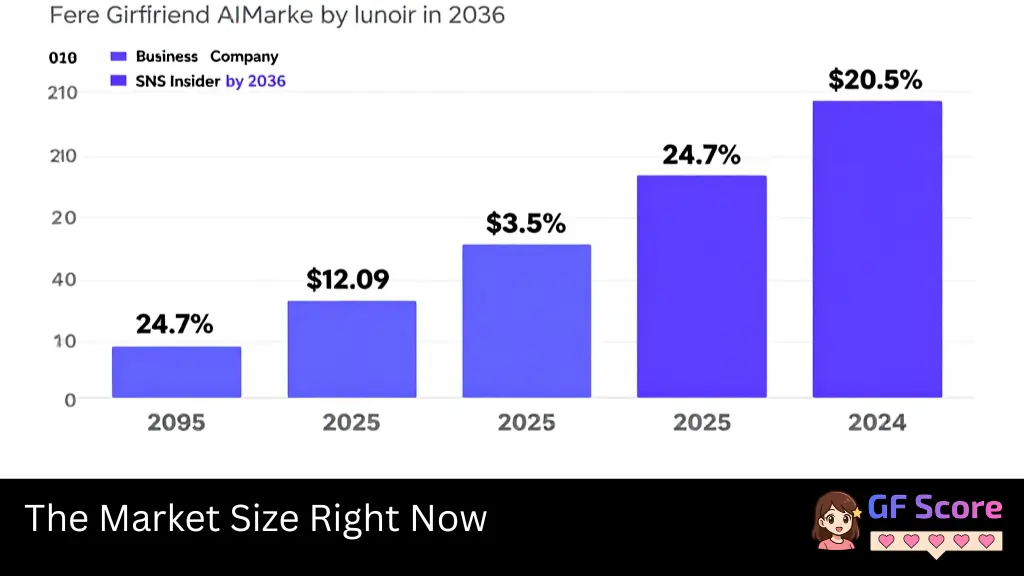
The Business Research Company puts the AI girlfriend app market at $2.91 billion in 2026, on a trajectory to hit $7.15 billion by 2030 at a CAGR of 25.2%.
SNS Insider runs a slightly higher estimate, $3.08 billion in 2025, growing to $19.09 billion by 2035 at a 20% CAGR.
Market.us positions the ceiling even higher, $24.5 billion by 2034, starting from a $2.7 billion base in 2024, with a 24.7% CAGR.
📊 Stat Insight Note: The wide variance across forecasting firms (from $7B to $24B by the mid-2030s) isn't sloppy research; it reflects genuine uncertainty about whether usage will plateau or compound.
The optimistic forecasts assume NSFW AI, emotional AI, and social AI merge into one category. The conservative ones don't. Both are likely partially right.
🤔 Where the Broader AI Companion Market Sits
The AI girlfriend niche exists inside a much larger “AI companion” universe.
The broader AI companion market was valued at $37.12 billion in 2025 and is projected to reach a staggering $552.49 billion by 2035, a 31% CAGR.
The AI companion apps segment (which includes virtual friends, mental wellness bots, and yes, AI sex chat apps) grew from $4.24 billion in 2025 to $5.01 billion in 2026 at an 18.1% CAGR.
📊 Stat Insight Note: The gap between the “girlfriend app” CAGR (25.5%) and the broader “companion app” CAGR (18.1%) tells you something important, romantic and sexual use cases are outpacing utility use cases. People aren't just using AI for productivity. They're using it for intimacy. That's a social signal, not just a business one.
The U.S. Market: Still The Biggest Player
North America, particularly the United States, dominates global AI girlfriend app revenue.
The U.S. AI girlfriend app market alone hit $0.89 billion in 2025 and is forecast to reach $6.61 billion by 2035 at a 22.19% CAGR.
This dominance is driven by advanced digital infrastructure, higher disposable income, and frankly, a culture that was already comfortable paying for virtual experiences well before AI made them emotionally convincing.
Asia-Pacific: The Fastest-Growing Region
If North America owns the market today, Asia is building it for tomorrow.
India's AI companion market alone was worth $1.035 billion in 2024, projected to hit $7.912 billion by 2030, a 40.4% CAGR, the highest of any major regional market.
China, Japan, and South Korea are driving usage among younger demographics navigating hyper-competitive social environments where forming real-world romantic relationships is increasingly difficult.
Southeast Asian markets, Indonesia, Thailand, and Malaysia, are seeing early-stage but accelerating adoption, particularly among urban smartphone users aged 18–28.
📊 Stat Insight Note: India's 40.4% CAGR isn't just about loneliness tech. It's about a young, digitally fluent population that outnumbers the entire U.S. population several times over, most of whom have never had access to premium social/romantic apps. AI girlfriend apps are their entry point. That's not a niche. That's a wave.
Search Behaviour: When Interest Became Demand
Market size figures tell you what the industry is worth.
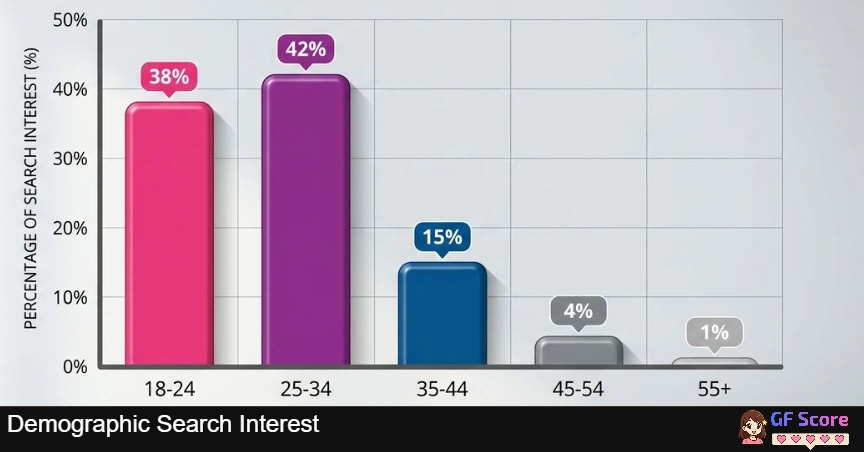
Search data tells you why people actually showed up.
Google searches for “AI girlfriend” surged 2,400% between 2022 and 2023, one of the sharpest single-year jumps for any consumer tech search term ever recorded.
“Virtual girlfriend” saw a 620% year-on-year global increase in search volume during the same period.
“AI companion” searches in the U.S. grew 490% in 2023 versus 2022.
By December 2023, the phrase “AI girlfriend” was searched 50,000 times in a single month, a 525% increase over December 2022.
As of early 2024, there were already 73,000+ monthly searches for AI relationship bots, and that figure has only climbed since.
📊 Stat Insight Note: Searches don't lie. When 2,400% growth happens in a single year for a consumer product category, it is not trend adoption. It's the suppressed demand finally finding a product. People were lonely before these apps existed. The apps just made the demand visible in a search bar.
Who's Actually Using These Apps

Demographics here are messier than marketers want to admit, and that messiness is the insight.
Around 28% of men aged 18–34 report having interacted with an AI girlfriend app or chatbot.
The average AI girlfriend app user is 27 years old, solidly Gen Z and younger millennial.
1 in 5 men on dating apps has tried an AI girlfriend in some form.
There are currently over 15 million users globally engaging with AI companion platforms.
Female users account for roughly 18% of the user base, a minority, but a growing one.
📊 Stat Insight Note: What looks like rapid, broad-based growth is actually concentrated adoption. Usage is skewed, heavily male, heavily under-35, and heavily urban. When headline numbers say “millions of users,” the active, paying user base is a narrower subset. Market maturity will require expanding beyond this core group. That hasn't happened yet at scale.
🤔 Why People Use Them: The Loneliness Economy
This is where the data stops being just numbers and starts being a social document.
86.7% of AI girlfriend app users report using the apps to combat loneliness.
A separate 2025 data point from AI companion platforms found 68% of users cite loneliness as their primary driver for use.
Beyond loneliness, users also report using these apps for entertainment (36.7%), curiosity (20%), and to practice real-world social and dating skills.
40% of users believe AI girlfriends could eventually replace real-life relationships entirely, a stat that is both fascinating and alarming in equal measure.
📊 Stat Insight Note: There's a critical distinction buried in this data. Most users aren't abandoning human relationships for AI ones, they're filling gaps between human interactions. The 40% replacement-belief figure is high, but belief and behaviour diverge. People say a lot of things at 2am. Usage data tells a different story at a population level.
💫 Engagement & Spending: The Stickiness Problem
User acquisition is cheap. Retention is everything.
55% of AI girlfriend app users interact with their virtual partner on a daily basis, a figure that rivals social media stickiness metrics.
The average user spends $47 per month on premium features, virtual gifts, and enhanced experiences.
One major platform reported 60% user retention after the first month, a number that beats most standard mobile apps by a significant margin.
📊 Stat Insight Note: $47/month average spend is not small. Netflix costs $15. Spotify costs $10. When users voluntarily spend $47 on virtual companionship, it signals emotional value that transcends entertainment utility. These aren't impulse purchases. These are recurring emotional investments, and that's what makes the subscription revenue model so durable for operators in this space.
Revenue Model Breakdown: How The Money Flows
The AI girlfriend app business isn't built on advertising like traditional social media.
It's built on subscriptions, token purchases, premium unlocks, and NSFW feature tiers, a pay-to-feel model that is unique in consumer tech.
Subscription-based revenues dominate, with NSFW chat, explicit image generation, and voice/video call features sitting behind higher-tier paywalls.
The market's projected growth to $7.15 billion by 2030 is explicitly tied to the expansion of these subscription revenue models and investment in emotionally intelligent AI.
Growth Drivers: What's Actually Fuelling This
Five structural factors are driving this market, none of them going away anytime soon.
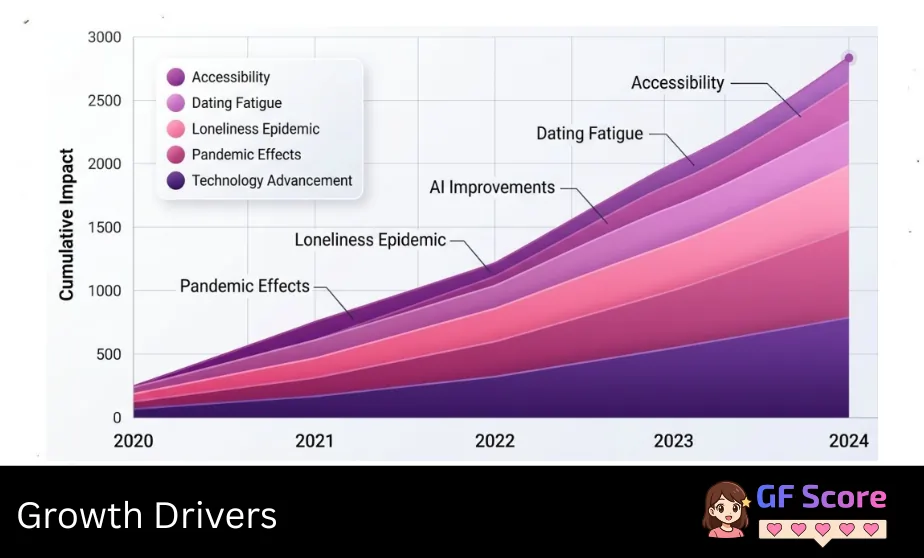
Demographic Shift: The Next Wave
The market's current user base is young and male.
But the next growth wave looks different.
Interest among older demographics, particularly men and women aged 35–55 seeking companionship after divorce, bereavement, or social isolation, is rising steadily.
Female adoption, currently at 18%, is expected to grow as AI boyfriend and gender-neutral companion apps expand their emotional intelligence features.
Asia-Pacific's young urban population, particularly in India, Indonesia, and Southeast Asia, represents hundreds of millions of potential users who haven't yet been onboarded to premium AI companion products.
📊 Stat Insight Note: The market's demographic centre of gravity is about to shift. The “lonely young man” user archetype will be joined by older, more financially stable users with different emotional needs, and higher willingness to pay. When that happens, average revenue per user climbs. That's what the $19B–$24B long-range forecasts are actually modelling.
😈 Usage Fatigue: The Risk No One's Talking About
Not all signals point up.
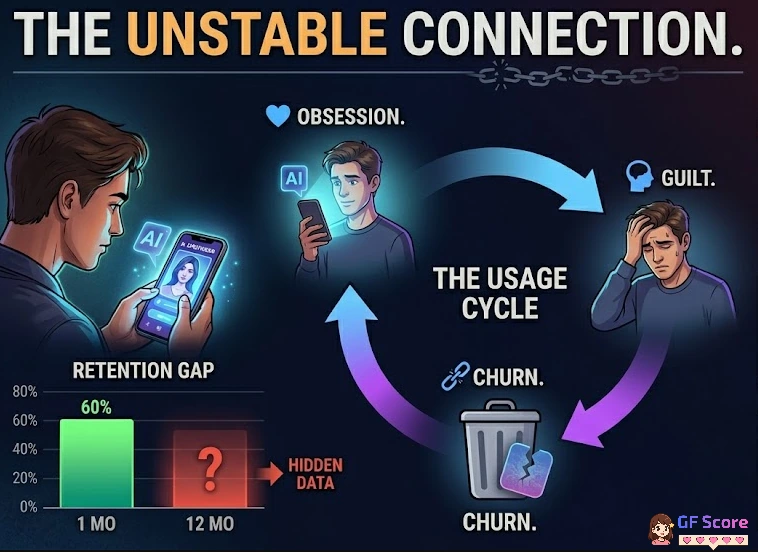
There is early evidence of usage fatigue and over-dependence loops, where users oscillate between heavy use and guilt-driven deletion.
The 40% “AI can replace relationships” belief figure is actually a usage risk, users who replace rather than supplement human connection are more likely to experience disillusionment when AI limitations become apparent.
Platform churn data shows that while first-month retention is strong (60%), long-term 12-month retention figures are far harder to find in published research, likely because they're less flattering.
📊 Stat Insight Note: Fast-growing markets with emotional dependency loops carry an underappreciated churn risk. If an AI girlfriend app fails to meaningfully upgrade its emotional intelligence at the same rate users' expectations rise, the relationship ends, and not politely. Usage fatigue is the silent ceiling on every bullish market projection in this space.
⚙ Technology Adoption Curve: Where We Actually Are
Using the classic Rogers adoption curve, the AI girlfriend app market is currently in the early majority phase, past early adopters, not yet mainstream.
The 2,400% search surge in 2023 marked the end of early adopter territory.
The $2.91 billion market value in 2026 places the industry firmly in early majority territory, real money, real users, but still significant resistance from mainstream consumers.
Full mainstream adoption, if it comes, would push the market toward the $20B+ projections currently sitting at the optimistic end of forecasts.
🎯 2026 Market Snapshot: Key Stats at a Glance
| Metric | 2026 Data |
|---|---|
| Global AI GF App Market Size | $2.91 billion |
| CAGR (2026–2030) | 25.2% |
| Projected Market by 2030 | $7.15 billion |
| Broader AI Companion Market (2026) | $5.01 billion |
| U.S. Market Size (2025) | $0.89 billion |
| India CAGR (2025–2030) | 40.4% |
| Daily Active User Rate | 55% |
| Avg. Monthly Spend Per User | $47 |
| Users Citing Loneliness as Driver | 86.7% |
| Male Users Aged 18–34 Who've Used One | 28% |
| Search Growth (2022–2023) | 2,400% |
🚀 Final Insight: What These Numbers Actually Mean
Here's the uncomfortable intelligence this data contains, most people miss it.
The AI girlfriend app market isn't growing because the technology got good.
It's growing because human connection infrastructure failed at scale first, and the technology showed up to fill the gap.
The 86.7% loneliness statistic isn't a product insight. It's a civilisational one.
Every CAGR projection in this market is, in one reading, a forecast for how lonely people are going to keep being, and how much they're willing to pay to not feel that way.
That's the real market driver. Not AI. Not apps. Not subscriptions.
Loneliness with a credit card, that's what $2.91 billion looks like in 2026.