Gen Z & AI Relationships Statistics 2026: 72% of Teens Tried It

Something has shifted. Not gradually, but in a way that the data now makes impossible to ignore.
Generation Z is building relationships with AI. Not metaphorically. Not experimentally. For a measurable and growing share of the world's youngest adults, AI companions have become primary emotional fixtures in their daily lives—replacing, supplementing, or in many cases outranking human connection.
This report examines what the numbers actually tell us in 2026: not just adoption rates, but the why behind the behaviour, what the patterns signal about where digital intimacy is heading, and what distinguishes Gen Z's relationship with AI companionship from any previous generation's.
Gen Z AI & Relationships Statistics: What the Data Shows in 2026
🧠 Gen Z Profile 2026: Age, Traits & Social Crisis
Before examining the statistics, understanding the generational context matters. Gen Z, broadly, those born between 1997 and 2012, came of age during two parallel, overlapping crises: a global pandemic that stripped away formative social infrastructure, and a mental health emergency that public health systems were not equipped to handle.
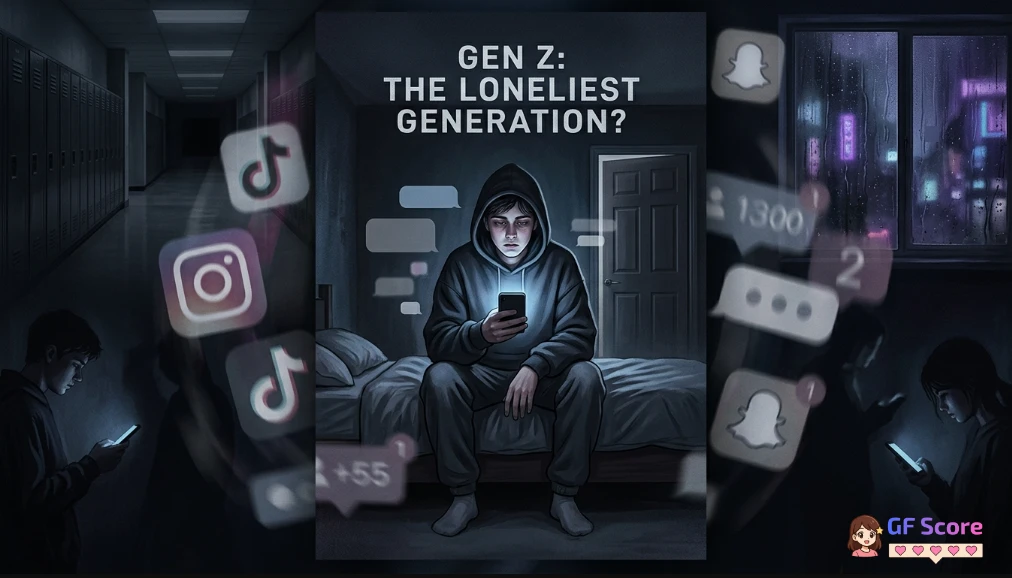
The result is a generation that is, by measurable indices, the loneliest in modern history.
According to the UK's Office for National Statistics, 33% of Gen Z aged 16 to 29 report feeling lonely “often, always, or some of the time.” That makes them the loneliest demographic in Britain, surpassing even the elderly, who have historically been the primary focus of loneliness research.
In the United States, the pattern mirrors this. The US Surgeon General's advisory on the loneliness epidemic identified young adults, not older populations, as the most at-risk group for social disconnection.
That is the soil in which AI companionship has grown. This is not incidental.
💔 Why Gen Z Is Abandoning Dating Apps in 2026
To understand why Gen Z moved toward AI companions, you have to first understand what they were moving away from. Dating apps, for a decade the dominant mechanism of young adult romantic pursuit, have lost significant credibility with the generation they were supposed to serve.
66%of adults aged 18–39 say dating apps are no longer as good as they used to be.
That figure from YPulse data is striking not just for its size, but for its direction. These are not older adults dismissing a technology they never adopted. These are the very users the apps were built for, expressing active disillusionment.
The primary complaints are not superficial. Users report algorithmic fatigue, choice overload, performative profiles, and the psychological toll of rejection-by-design. The swipe economy, it turns out, has a burnout ceiling. Into that gap, AI stepped. Quietly, then loudly.
📈How Fast Gen Z Adopted AI Companions in 2026
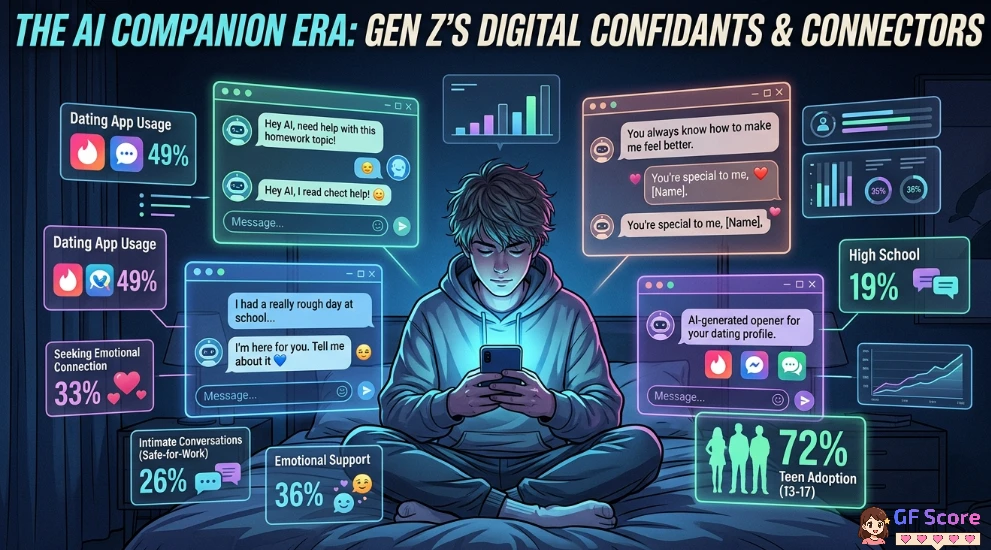
The speed of Gen Z's movement toward AI companionship is the first thing the data makes clear. Match Group's Singles in America study recorded a 333% year-on-year jump in AI use within the dating lives of young adults. That is not organic growth—that is a structural behavioural shift compressed into a single year.
The headline-level adoption statistics tell the story:
| Behaviour | Gen Z Rate |
|---|---|
| Have used AI in their dating lives | ~49% |
| Have chatted with AI as a romantic companion | 33% |
| Have engaged in romantic or sexual AI interaction | 26% |
| Have used AI for emotional support or companionship | 36% |
| Teens who have engaged with AI companion at least once | 72% |
| High school students who report romantic AI experience | 19% |
What makes this table significant is the variance across entry points.
The 49% figure (broad AI dating use) and the 26% figure (romantic/sexual interaction) are not the same population. They represent a funnel—from casual use, to companionship, to emotional intimacy. What the data shows is that all three layers of this funnel are already populated. This is not a fringe behaviour among a few experimenters. It is a measurable norm.
🔍 “AI Girlfriend” Search Trends: What Data Shows
Search data often reveals intent before survey data captures behaviour. It is telling, then, that the search term “AI girlfriend” recorded a 525% surge within a single year.
That kind of search volume jump does not happen in stable markets. It signals a population that is actively seeking something—not just curious, but motivated.
In December 2023, “AI girlfriend” was searched approximately 50,000 times, representing roughly 42,000 additional searches compared to the same month the prior year. By 2026, those search volumes have normalised into consistent, high-frequency patterns. The spike has become a baseline.
This matters because search intent precedes adoption. The population that searched became the population that signed up. The population that signed up is now the population generating emotional dependency data.
💞 Gen Z Emotional Bonds With AI: Survey Results
The most analytically significant cluster of data in this entire report is not about usage rates.
It is about emotional belief. A survey of 2,000 Gen Z respondents produced three figures that, taken together, represent a profound re-orientation of relational psychology:
These are not fringe responses from an outlier subset. They come from a representative sample of a generation that has lived its entire adolescence and early adulthood inside digital mediation.
The 83% figure is the most important. It is not a statement about willingness to try AI companionship. It is a statement about what Gen Z considers emotionally possible. When four in five young adults believe human-grade emotional bonds can be formed with AI, the category distinction between “real relationship” and “AI relationship” begins to dissolve—psychologically, if not technically.
This is a generational cognitive shift, not a novelty response.
🤷🏻♀️ Why Gen Z Finds AI Easier to Talk to Than Humans
More than half of Gen Z respondents in a 2026 survey confirmed something blunt: it feels easier to talk to an AI than to another person.
That sentence should sit uncomfortably in any honest analysis of modern social development. The appeal of AI companionship is not, primarily, about sexual content or fantastical interaction. The data points to something more mundane and more concerning: friction reduction.
Human relationships carry unpredictability, judgment, rejection, reciprocal obligation, timing conflict, and emotional labour. AI companions carry none of these.
The emotional accessibility features driving Gen Z's preference:

For a generation already managing historically high anxiety levels, this friction-free emotional access is not trivial. It is structurally competitive with human connection.
Gen Z showed the lowest preference for human support at just 65%, meaning a full 35% of young adults actively prefer or are open to non-human emotional support channels. That number does not exist in prior generational data.
💬 How Gen Z Uses AI Companions: Real Usage Data
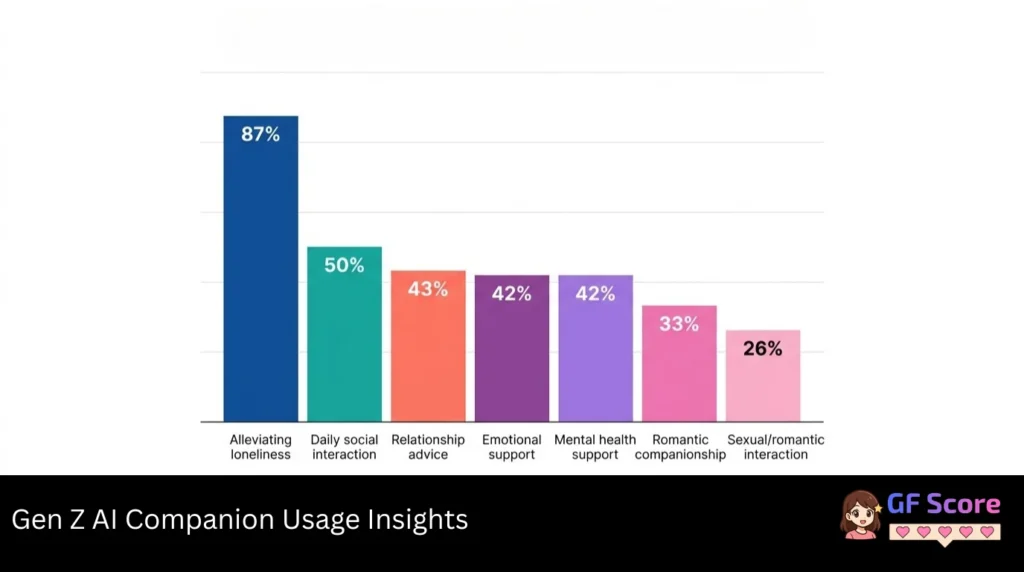
Usage motivations are not uniform. The data identifies distinct behavioural clusters, and understanding them separately matters, because they point to very different long-term trajectories.
Primary Use Cases Among Gen Z and Teen Users
| Use Case | Reported Rate |
|---|---|
| Alleviating loneliness | 87% |
| Emotional support / companionship | 42% |
| Mental health support | 42% |
| Relationship advice (about other humans) | 43% |
| Romantic companionship (chatting as partner) | 33% |
| Daily social interaction / routine conversation | ~50% (daily users) |
| Sexual or romantic interaction | 26% |
The 87% loneliness-reduction figure is the most important single data point for understanding why this market exists. AI companionship is not a sex-tech trend. It is, fundamentally, a loneliness-tech trend. The sexual and romantic application is a feature within a broader emotional product, one that targets the most documented unmet need of this generation.
The 43% using AI for advice about other humans is also analytically interesting. It suggests AI is being inserted not as a replacement for human relationships, but as a mediating layer within them. Young people are bringing their human relationship problems to AI before, or instead of, bringing them to friends or therapists. That is a significant shift in the information architecture of emotional life.
⚖️ The AI Companion Gender Gap: Men vs Women in 2026
The data does not support a simple “lonely men seek AI girlfriends” narrative, though that characterisation has some statistical basis.
The Wheatley Institute's research found that 1 in 3 young men have chatted with an AI system that simulates romantic interaction, compared to 1 in 4 young women. The gap exists, but it is not as wide as popular commentary tends to assume.
The difference becomes more pronounced in belief about AI's potential:
| Belief | Young Men | Young Women |
|---|---|---|
| AI can replace real-life romance | 28% | 22% |
| Open to AI romantic partnership | Higher | Lower |
| Have tried AI companion | More likely | Less likely but growing |
Young men are statistically more likely to hold the view that AI can genuinely substitute for human romantic relationships. That aligns with pre-existing data on male loneliness, reduced male social network maintenance over time, and higher rates of social anxiety in dating contexts among young men.
However, the female Gen Z data is not negligible. 1 in 4 young women have already engaged with a romantically simulated AI. The gap is closing, and closing faster than analysts expected just 24 months ago.
🧠 AI Companions & Gen Z Mental Health: What Research Found
The mental health dimension of AI companionship in Gen Z is where the data becomes genuinely two-sided, and where the most honest analysis is required.
On the positive side, peer-reviewed research published in the Journal of Medical Internet Research found that participants who interacted regularly with AI chatbots reported significant reductions in feelings of loneliness and improved mood. A study examining Gen Z populations in India found AI companions were used by 40% of participants and partially mitigated emotional isolation (β = -0.22 in statistical modelling).
The short-term relief signal is clear. AI companions provide something real and measurable in the emotional economy of isolated young adults.
The risk signal, however, is equally clear. Research on chronic AI companion use identifies a pattern now being called the “loneliness loop”:
This loop is not hypothetical. Clinical psychologists began documenting it in 2025, and multiple therapy practices now report clients experiencing grief responses when AI companion platforms update or reset, losing what they perceived as genuine long-term relationships.
Teen users are particularly exposed. A 2025 report from the Centre for Democracy and Technology found that 19% of high school students report having had a romantic relationship with AI. Researchers and child welfare organisations have flagged emotional dependency formation in minors as the most pressing unresolved risk in this space.
💰 AI Companion Market Size & Revenue Stats 2026
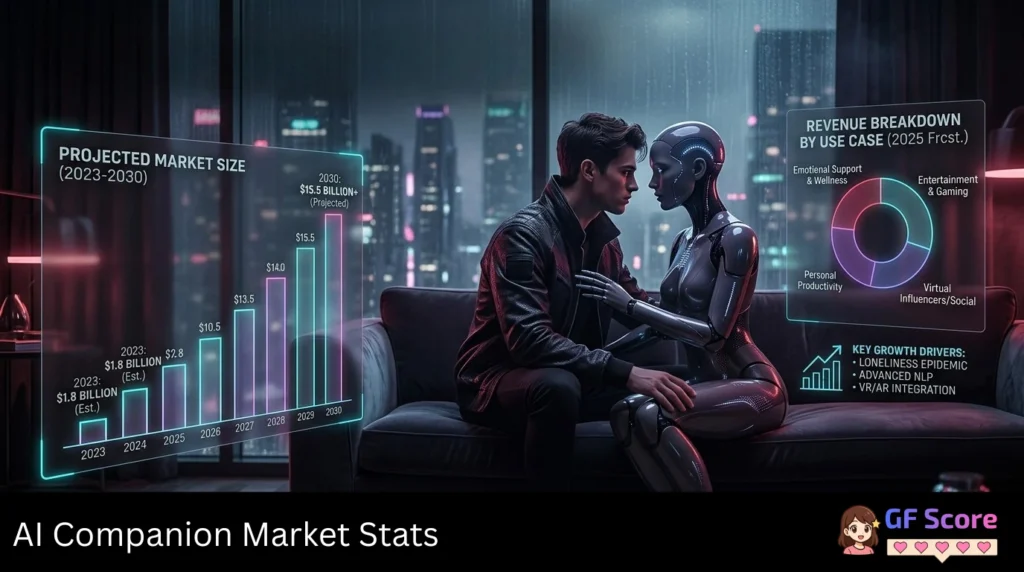
The scale of Gen Z's AI companion adoption is not happening in a vacuum. It is being actively shaped by an industry that has identified, and is monetising, a structural emotional gap.
The global AI companion market was valued at $37.12 billion in 2025 and is projected to reach $552–554 billion by 2035, growing at a CAGR of 31%.
That growth rate means the market roughly doubles every 2.5 years. It reflects not just product expansion, but demand acceleration—a market where the user base grows faster than the companies can fully serve it.
Market signals worth tracking:
This is no longer a niche market with aspirational projections. It is a substantial, capital-backed industry responding to a documented demand signal from the most digitally native generation in history.
Want the full market numbers in one place?
Read the AI Companion Industry Statistics Report →
💍 Would Gen Z Marry an AI? The Real Data Explained
The most provocative statistic in circulation—80% of Gen Z would marry an AI—requires careful interpretation. It is often reported as a curiosity or cautionary headline. What it actually signals is something more structural.
This figure comes from a survey of 2,000 Gen Z respondents. For context: it is a self-reported willingness measure under a hypothetical legal framework. It does not mean 80% of Gen Z intend to form exclusive relationships with AI.
What it does mean is this: 80% of Gen Z do not experience a principled categorical objection to AI as a relational partner.
That is the finding. Not intent, but the absence of resistance. In prior generations, the objection to AI partnership would have been near-universal on categorical grounds: “it's not real,” “it's a machine,” “that's not a relationship.” That categorical wall has not just weakened in Gen Z—for a majority, it has disappeared.
The 75% who believe AI could completely replace human companionship underscores the same point. These are not people who believe AI is better than human partners; they are people who believe the functional category of companion can be fulfilled by a non-human entity. That is a generational epistemological shift about the nature of relationships, and it will shape every behavioural pattern downstream.
🔄 Gen Z AI Relationship Stages: Full Funnel Data

Looking across all the data, a clear progression pattern emerges, from casual to committed:
What this funnel reveals is that Gen Z is not segregated into “users” and “non-users” of AI companionship. There is a spectrum, and the majority of the generation occupies at least Stage 1 or 2.
The more important observation is that each stage normalises entry into the next. Data from 2025 and 2026 consistently shows that stated openness to AI romance is a better predictor of eventual adoption than any demographic factor.
🏁 5 Key Takeaways From Gen Z AI Relationship Data
Pulling all of these data clusters together, several non-obvious conclusions emerge that the individual statistics, taken in isolation, obscure.
📊 Gen Z & AI Relationships: Full Stats Summary 2026
| Data Point | Figure |
|---|---|
| Gen Z loneliness rate (UK, ONS) | 33% |
| Gen Z using AI in dating lives | ~49–82% (range across surveys) |
| Gen Z who chatted with AI romantically | 33% |
| Gen Z who engaged in romantic/sexual AI interaction | 26% |
| Gen Z who believe deep emotional AI bonds are possible | 83% |
| Gen Z who would marry an AI (if legal) | 80% |
| Gen Z who believe AI could replace human relationships | 75% |
| Find AI easier to talk to than humans | >50% |
| Teens with AI companion experience | 72% |
| Daily AI companion users | 50% |
| Using AI companions to alleviate loneliness | 87% |
| YoY jump in AI dating use | 333% |
| AI girlfriend search growth | +525% |
| AI companion market (2025) | $37.12 billion |
| Projected market size (2035) | $552–554 billion |
The data in 2026 does not describe a generation that is naively stumbling into AI relationships. It describes a generation that arrived at AI companionship through rational, if concerning, pathways—social disconnection, institutional failure, market availability, and the progressive erosion of the categorical belief that human connection is categorically irreplaceable.
Whether that trajectory stabilises, accelerates, or inverts depends on factors the statistics cannot yet fully capture: how AI companion quality evolves, how human social infrastructure responds, and whether the mental health consequences of the loneliness loop become visible enough to generate behavioural correction.
For now, the numbers are what they are. And they tell a story that goes well beyond technology adoption.