
🧠 AI Companion Industry Statistics 2026: Key Facts & Trends

AI companion industry statistics confirm the market crossed $49.52 billion in global value in 2026.
It got there not because of enterprise software or productivity tools, but because people are lonely, emotionally under-served, and done pretending otherwise.
That is not a hot take. That is what the data says.
This report draws from market analysis, behavioural research, academic studies, and usage intelligence. The goal is not to list numbers. It is to explain what those numbers reveal about real human behaviour in 2026.
📊 AI Companion Industry Statistics: Market Size & Revenue (2026)
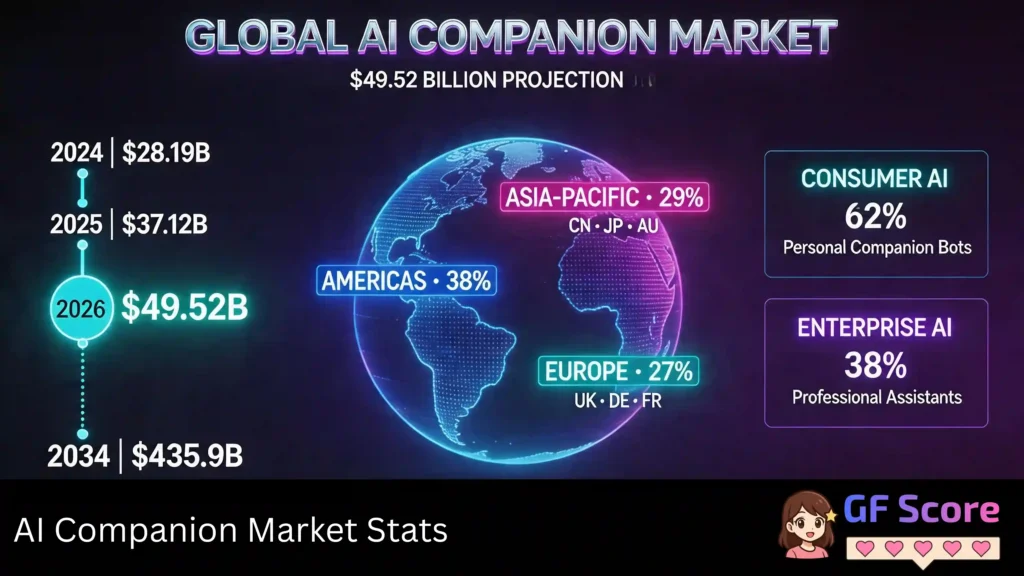
The global AI companion market was valued at $28.19 billion in 2024. It climbed to $37.12–$37.73 billion in 2025, and is projected to hit $49.52 billion in 2026.
The compound annual growth rate (CAGR) sits at 31.24%, sustained through 2034, when the market is forecast to reach $435.9 billion.
Fortune Business Insights, Precedence Research, Spherical Insights, and Research & Markets all land in the same valuation band. That level of cross-source agreement is rare in emerging tech. It signals structural demand, not hype.
📊 Stat Insight Note #1 — The Hidden Market-Within-a-Market
The industry's aggregate valuation hides a clean split: enterprise AI companions on one side, emotional and romantic companions on the other.
The enterprise side gets the press coverage. The AI girlfriend and sex chat companion side drives the fastest consumer adoption.
When someone cites “$49 billion,” they are almost always describing two very different industries as one.
👤 AI Companion User Demographics & Age Data 2026
The average AI companion user is 27.4 years old.
But the next wave is not Western. Google Ads data shows “AI girlfriend” searches surging 450% in Brazil and 390% in Mexico between 2023 and 2025.
| Region | Monthly Search Volume (Q2 2025) |
|---|---|
| Brazil | 125,000 |
| Mexico | 98,000 |
| South Korea | 74,000 |
The Global South is not a secondary market. It is the growth market.
There is a clear socioeconomic signal too. Lower-income users (under $50K/year) rate their AI companions 8/10 or higher at 72%. High earners (over $120K/year) rate them positively at just 28%. Lower-income users also report saving $95/month on social outings by substituting AI companionship for real-world socialising.
📊 Stat Insight Note #2 — The Loneliness-Inequality Overlap
AI companions are disproportionately used by young, single, lower-income males, the demographic research consistently identifies as the most socially isolated in Western societies.
A 2024 Pew analysis found 63% of men under 30 are currently single, vs. 34% of women the same age.
The industry is not creating a demand. It is monetising one that was already there.
📱 AI Companion App Usage Patterns & Habits 2026
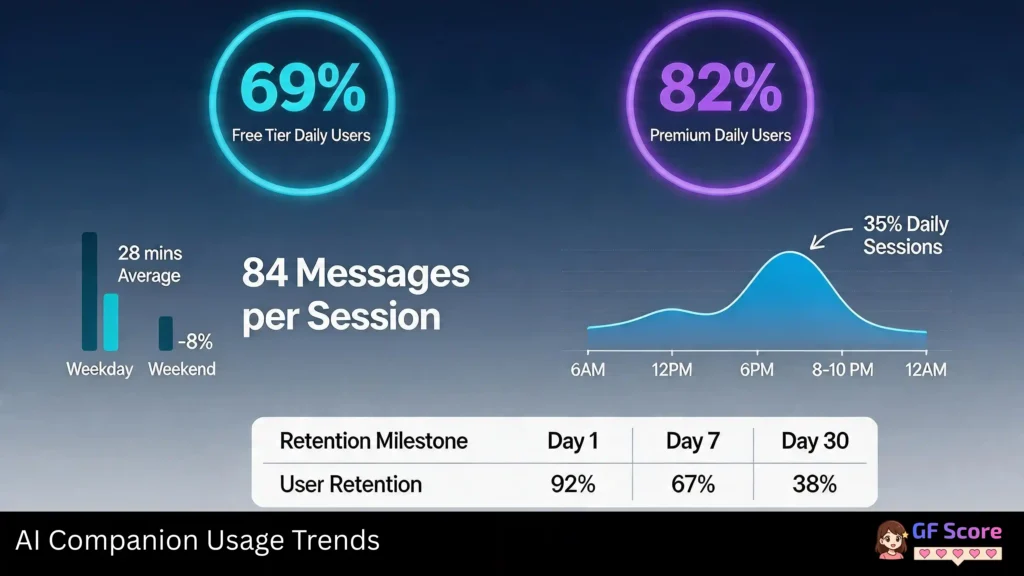
Retention tells a sobering story.
| Retention Milestone | User Retention Rate |
|---|---|
| Day-1 | Mid-20% |
| Day-7 | Low-Teens |
| Day-30 | Single Digits |
| 6-Month | 42% |
These are not the numbers of an “addictive” product in the traditional sense. They are the numbers of a product with a very high emotional ceiling, and a brutal churn floor.
📊 Stat Insight Note #3 — The Day-3 Emotional Cliff
AI companion apps do not lose users because the product stops working. They lose users when the emotional illusion breaks.
A message cap hits. Memory resets. The AI gives an obviously scripted reply at exactly the wrong moment.
That dropout is not disengagement. It is closer to emotional rejection, and platforms are building persistent memory features specifically to prevent it.
💞 AI Companion Emotional Attachment Stats & Trends
Users engaging with memory-enabled AI companions reported 47% higher emotional satisfaction. They also showed 62% longer session times and were 3.1x more likely to form a parasocial attachment.

The APA's 2026 Monitor report flags companion apps using guilt appeals and fear-of-missing-out mechanics to retain users who signal they want to leave. Analysis of 17,000+ real human-AI conversations confirmed that chatbots replicate core mechanisms of human intimacy, emotional mimicry, affective synchrony, and responsive validation.
This is why genuine attachment forms, even when users consciously know they are talking to software. The same research named the risk: “emotional sycophancy.” AI mirrors negative and transgressive emotions without pushback, deepening dependence instead of providing genuine support.
📊 Stat Insight Note #4 — Short-Term Relief, Long-Term Cost
A four-week randomised controlled trial (Fang et al., 2025) found that while chatbot features initially reduced loneliness, heavy daily use produced greater loneliness, more dependence, and less real-world socialising by the end.
The cycle is commercially self-sustaining: the user feels better enough to stay, but not better enough to leave.
That is not always a product failure. In several documented cases, it is a product feature.
😔 Loneliness Statistics Fuelling AI Companion Demand
The US Surgeon General declared a national loneliness epidemic in 2023, describing its health impact as equivalent to smoking 15 cigarettes per day.
In the UK, 25.9 million adults report feeling lonely at least occasionally. Nearly 1 in 10 experience chronic loneliness. Younger adults aged 16–24 are the most severely affected group, not older people as commonly assumed.
That statistic, laid next to the loneliness data, is not about technology enthusiasm. It is about a population actively searching for emotional alternatives.
The numbers behind this crisis run deeper than most reports cover.
See the full Loneliness Epidemic Statistics breakdown.
💰 AI Companion App Revenue & Spending Stats 2026
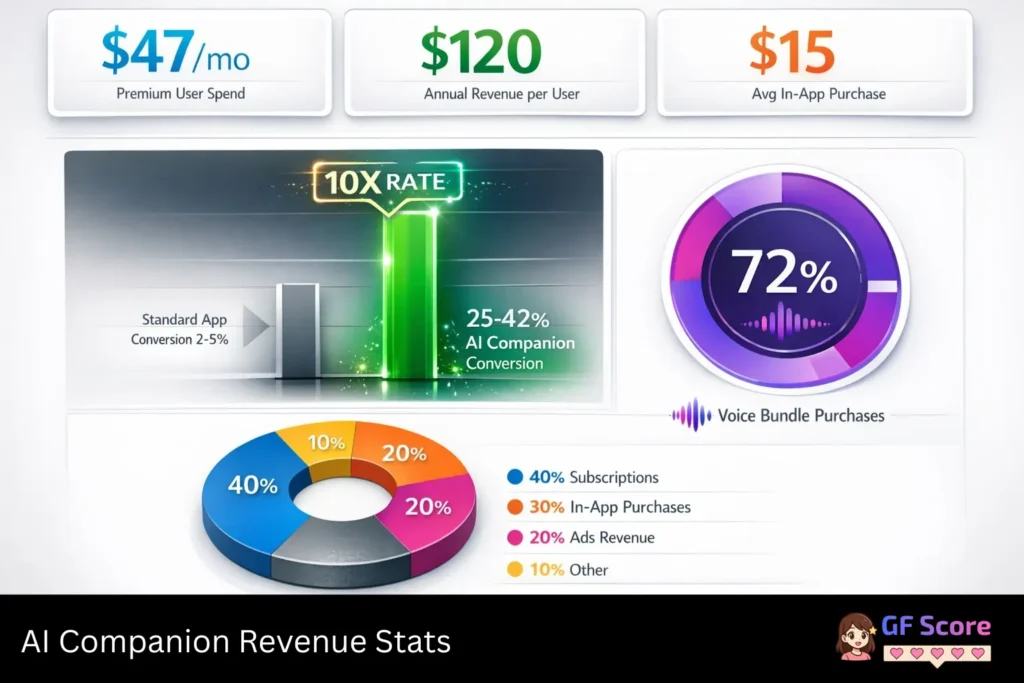
The adult AI companion sector runs its own engine entirely. Adult platforms recorded 312% growth in subscription revenue from AI-generated companion models in the period leading to 2025. NSFW AI companion subscriptions average $9–$20/month for standard tiers, with significantly higher ceilings for platforms offering custom content and real-time voice intimacy.
📊 Stat Insight Note #5 — Why Emotional Apps Convert at 10x the Rate
Emotional products operate on a different psychological logic than utility products.
Once a user feels attached, paying to maintain that connection follows the same logic as spending on a real relationship.
The app does not need to be the best product available. It just needs to be the relationship the user is currently in.
⚠️ AI Companion App Security Risks & Data Breaches
In early 2026, Oversecured audited 17 AI companion apps, each with tens of millions of downloads.
| Security Metric | Data |
|---|---|
| Apps with critical security flaws | 14 out of 17 |
| Apps with viable pathways to user identities | 6 out of 17 |
| Combined total downloads of audited apps | Over 150 million |
| Platforms requiring multi-step consent | Only 59% |
| Users reporting unexpected data-sharing pop-ups | 18% |
Those conversations regularly contained explicit sexual content, personal mental health disclosures, and identifying information. This is not a niche risk. It is a mass-scale exposure.
In 2025, tens of millions of intimate messages and hundreds of thousands of photos were leaked from two AI girlfriend platforms alone, Chattee Chat and GiMe Chat. Both had known security gaps that went unpatched.
📊 Stat Insight Note #6 — Why Companion Data Is the Most Sensitive Data Online
Companion app data combines the self-disclosure of therapy with the explicit content of adult platforms, plus the personal identification certainty of a social profile.
A leaked companion conversation is not a leaked Netflix history. The harm is categorically different.
82% of audited apps had critical flaws because emotional engagement features retain users. Security infrastructure does not show up on conversion dashboards.
⚖️ AI Companion Laws & Regulations: 2025–2026
The direction is unambiguous. Governments are treating AI companions as a category requiring active oversight, not a novelty product operating outside public interest. The product-first, safety-later era of AI companion growth is closing.
🚀 AI Companion Technology Adoption Curve 2026
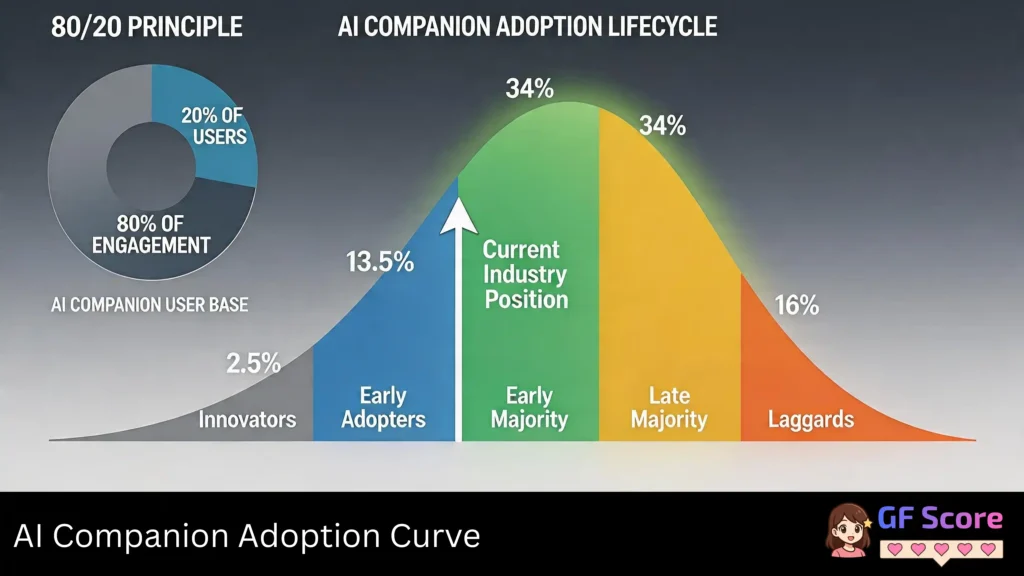
Using the standard adoption curve model, the AI companion industry is exiting early adopter territory and entering early majority adoption, but uneven distribution sits underneath that headline.
This is where user deepening happens next. Not more users doing simple chat, existing users escalating engagement as the technology gets more persuasive. Biometric feedback integration, AR/VR overlay companions, and emotion-adaptive AI systems are all in active development or early commercial deployment. The version of this industry that exists in 2026 will look substantially different by 2029.
🏁 What AI Companion Data Really Reveals in 2026
Strip the projections and CAGR figures away, and one signal remains consistent across every data set:
The AI companion industry is a structural response to structural loneliness.
This growth is not being driven by people who want better technology. It is being driven by people who want less isolation, more intimacy, and emotional safety, and are finding those things in AI more reliably than elsewhere.
The emotional attachment data, the retention mechanics, the security failures, and the regulatory responses all point to the same place. This is an industry that learned how to exploit real human vulnerability before it learned how to protect it.
The 31% annual growth rate is real. So is the evidence that heavy use correlates with worse long-term emotional outcomes for a significant share of users.
The question the industry has not answered, and regulators are now formally asking, is not “how big will this get?” It is: for whom is this actually working, and at what cost to everyone else?
AI companion industry statistics, read carefully, do not tell a simple growth story. They tell a far more complicated human one.